Suffering from common cold? Take larger doses of Vitamin C, which may significantly help in reducing the duration of the viral infection, a study shows. ALSO READ | Diet Diary: How much Vitamin C is too much? The findings showed that people who consumed six-eight grams of Vitamin C per day during their cold helped them reduce its duration. Vitamin C administration does not decrease the average incidence of colds in the general population, yet it halved the number of colds in physically active people, the researchers said. ALSO READ | Can vitamin C supplement replace your daily morning walk? “Given the consistent effect of Vitamin C on the duration of colds, and its safety and low cost, it would be worthwhile for individual common cold patients to test whether therapeutic eight gram per day Vitamin C is beneficial for them,” said Harri Hemila from the University of Helsinki, Finland. “Self-dosing of Vitamin C must be started as soon as possible after the onset of common cold symptoms to be most effective.” Hemila added, in the paper published in the journal Nutrients. Vitamin C is also present in bell peppers, dark leafy greens, kiwi fruit, broccoli, berries, citrus fruits, tomatoes, peas, and papayas. Various animal studies have found that Vitamin C significantly prevents and alleviates infections caused by diverse bacteria, viruses, and protozoa. However, the practical importance of Vitamin C in human infections was not yet known. For the study, the team analysed two randomised trials which investigated the effects of two Vitamin C doses on the duration of the common cold. The results showed that people who had six gram per day dose of Vitamin C shortened the duration of cold by 17 per cent, while the eight gram per day dose shortened the duration of cold by 19 per cent. For all the latest Lifestyle News, download Indian Express App now Consume Vitamin C foods! (Source: Thinkstock Images)
Thứ Sáu, 31 tháng 3, 2017
Suffering from cold for a long time? Take higher dose of Vitamin C
Diet diary: Don’t turn Navratra fasting into a feast
NAVRATRAS, the nine-day fasting period, rooted in the Hindu religion, offers some great opportunities to re-focus on your diet and take corrective measures. However, if made into a feast, it can be more damaging than your usual diet and lead to weight gain. These days, even restaurants in our cities offer a range of speciality foods loaded with calories—the reason behind the post-Navratra kilos. During the Navratras, alternate grains are eaten and traditional staples like wheat, rice, pulses and most vegetables are prohibited. The fast is observed with altered eating practices. The usual range of cereals like rice, wheat and millets are replaced by alternate cereals such as buckwheat, chestnut, sago, amaranth and a special variety of rice, known as samak rice (Barnyard millet). Amaranth, chestnuts and samak are in fact not true cereals. Rather, they are seeds of fruits, also referred to as pseudo cereals. Pseudo cereals are higher in protein and are rich in carbohydrates like conventional cereals — wheat and rice. One of the principles of healthy eating is bringing variety into your food and the forgoing of certain foods in favour of others takes care of this. Here is how you can make the fasting period work in your favour. # Eat small portions but do not starve. # Include plenty of fluids, water, fresh fruit and vegetable juices. # Include foods rich in micronutrients, anti-oxidants and phytochemicals (disease fighting nutrients)—fruits and vegetables. # Include variety through alternate foods, cooked healthily, and ensure good nutrition. # Break your fast with coconut water/ milk/yoghurt/buttermilk/vegetable or fruit juice/soup/fruits. # Do not eat too much immediately after breaking your fast. Plan one major meal with alternate grains, prepared in minimal oil, and ideally have it before sunset. Snack on milk, yoghurt, fruits, nuts, seeds, dry fruits and coconut. Such a diet can help you drop kilos and boost energy. These principles conform to scientific principles of nutrition. Balancing everyday eating patterns with controlled eating—as done during a fast—when practiced on a regular, long-term basis, can indeed prove to be healthy. It not only helps in controlling weight, but also promotes better digestion, improves energy, prevents diseases and promotes a feeling of lightness and well-being. For all the latest Lifestyle News, download Indian Express App now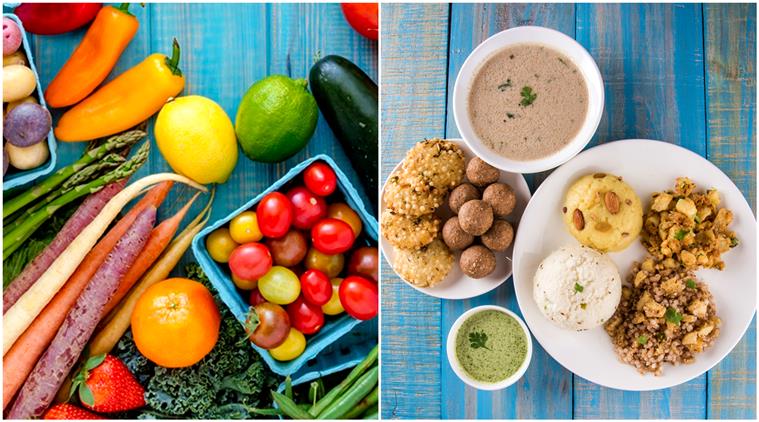 The usual range of cereals like rice, wheat and millets are replaced by alternate cereals such as buckwheat, chestnut, sago, amaranth and a special variety of rice, known as samak rice (Barnyard millet).
The practice of preparing oily, deep-fried snacks and sweets in the name of tradition must be checked. So, remember to take your fast in the spirit in which it is meant—give up life’s pleasures for nine days to bring back balance in your life.
High sugar levels? Start eating chickpeas, beans and peas to lower diabetes risk
A higher consumption of legumes — such as lentils, chickpeas, beans and peas — has the potential to lower the risk of developing Type 2 diabetes by 35 per cent, researchers say. ALSO READ | High-fiber diet may check onset of diabetes Legumes are a food group rich in B vitamins, contain different beneficial minerals — like calcium, potassium and magnesium. ALSO READ | Mediterranean diet may help treat HIV, diabetes patients The findings showed that among the different subtypes of legume, participants who had a higher consumption of lentils — one serving per week — had a 33 per cent lower risk of developing the disease. Legumes also contain sizeable amounts of fibre and are regarded as a low-glycemic index food, which means that blood glucose levels increase only slowly after consumption. The effect of replacing half a serving per day of foods rich in protein or carbohydrates, including eggs, bread, rice and baked potato, with half a serving per day of legumes was also associated with a lower risk of Type 2 diabetes, said Nerea Becerra-Tomas, researcher at the Universitat Rovira i Virgili in Spain. Due to these unique nutritional qualities, eating legumes regularly can help improve human health. The Food and Agriculture Organization of the UN (FAO) had declared 2016 as the international year of legumes to raise people’s awareness of their nutritional benefits. Type 2 diabetes is a chronic condition that affects the way the body processes blood sugar (glucose) and affected more than 400 million adults in 2015 worldwide. For the study, published in the scientific journal Clinical Nutrition, the team examined 3,349 participants at high risk of cardiovascular disease but without Type 2 diabetes. For all the latest Lifestyle News, download Indian Express App now Legumes are good for health! (Source: Thinkstock Images)
There's a Major Problem With Those Viral Weight-Loss Photos That Nobody's Talking About
From Redbook
Obviously, you have the internet, since you’re reading this post, so I’m going to make the assumption that you’ve been on Instagram at some point. To that end, I will guess that you have seen a transformation photo.
You know exactly what I’m talking about: two side-by-side photos of a woman, one in which she is her Before Self. She might look a little soft. Maybe her thighs touch. Maybe she’s not perfectly toned. She’s certainly not ugly. In the photo to the right, she is – voila! – a new person with abs, biceps, and little to no fat. She’s in workout clothes or underwear. She is transformed.
There’s something about those photos that really, really bothers me.
I get the impulse for wanting to make a then and now comparison. Maybe you feel better now than you used to and want to rejoice in that fact. Maybe you started working out for the first time in your life or started eating healthy and you want to show off the results. Maybe you worked hard to lose 5 pounds or to sculpt a six-pack, and you love seeing how far you’ve come. That’s all fine.
I am all for wanting to be the best version of yourself. There’s nothing wrong with priding yourself on making a dramatic journey from unhealthy to healthy. So I understand why some people post progress pictures. It can be very satisfying and helpful to track your changes; that’s why groups like Weight Watchers exist and have been so successful – they provide people with a support network and a way to hold yourself accountable. I don’t think weight loss is bad. Sometimes, when your health is at stake, it’s necessary.
What bothers me is the idea behind the majority of these photos: that comparing yourself is an OK thing to do, and that whatever came after is inevitably better than whatever was before. It’s the idea that whatever you looked like before was not good enough, and, to that end, you were not good enough, either.
Unfortunately, that’s the message I see perpetuated on social media – especially on Instagram – where social media influencers send messages to their followers that “this – not that!” is what’s good. These same influencers also often post platitudes like, “you’re beautiful no matter what you look like!!!!!!1😊” which is weird, because by posting a before and after photo of someone, it’s definitely implied that the after picture is the “better” picture.
These influencers know that women on Instagram want to hear body positive words, but that they also want the secret to rippling abs.
Make no mistake: That’s the message they’re trying to send. The bubbly, often grammatically unsound, emoji and typo-laden copy plays to the fact that these influencers know that women on Instagram want to hear body positive words, but that they also want the secret to rippling abs. Sure, these influencers claim to be promoting “confidence,” but they’re not encouraging the real confidence that comes with accepting your body as it is and treating it well by exercising and eating right. They’re talking about the confidence that could come with joining their network and following their lead, which is explicitly about all about your outside, not what’s inside. It’s a “confidence” you can get by punishing yourself and chastising your present body, desperately searching for your own “after” body.
Because don’t forget that Instagram influencers, after all, are looking to bolster their personal brands and ramp up their followings, and they probably want you to buy their training program or sign up for some app or YouTube channel. By posting before and after photos with “CONFIDENCE!!!!!” written all over or underneath them, they’re not-so-subtly telling women that this – the transformation – is how you get confident. So hop on the bandwagon, or forever feel like a lesser-than version of yourself.
These transformation photos – often taken from a woman with a small following and blasted out via an influencer’s account to millions of followers – invite comparison to yourself, which is just unnecessary and cruel. No matter how much better you feel about yourself at your new weight, and no matter how great you objectively look, there’s no point in shitting on what you used to be. Worse, posting these photos on very public forums invites a whole other group of people you may not even know to the criticism and comparison party (worst party ever, by the way).
I’m sick of seeing Instagrammers use body positive jargon when the message they’re pushing isn’t body positive at all. Instead, it promotes the idea that you need to change in some way – get even smaller, shrink your waist even more, have bulging muscles – to be happy, which is the very opposite of body positivity actually means. Body positivity is about celebrating where you are now.
And I’m tired of the idea that confidence is a construct that only exists in comparison to something else. I want people to stop trying to disguise weight loss as ~confidence and joy~. Confidence comes from within, not from an external source. Maybe after you’re in better shape you will feel better about yourself, but there’s no reason to push the idea that you need to change to feel that way.
No matter what a transformation photo shows on the surface, they send the message that you think less of what you were before, which is bullshit. And anyone who pedals the idea that confidence can only be found in rippling abs and tiny waists isn’t worth your sit-ups, burpees, time, or likes. You’re better than that. We all are.
Follow Redbook on Facebook.
You Might Also Like
Navratri fasting: Why it might just be healthy for your body
A celebration of Shakti, Navratri is observed to worship Goddess Durga. The nine nights of devotion holds a deep significance for Hindus. To observe it with purity and piety, people fast during the festival. From choosing the right flour to avoiding salt and spices, the vrat (fasting) food is fairly specific. Only selective ingredients such as kuttu atta, singhara atta, fresh vegetables, fruits, milk, yogurt and makhanas are allowed. ALSO READ | Navratri Special: 3 quirky recipes to feast on the festival To get in tune with the traditions, even hard-core foodies give up on non-vegetarian dishes, onion, garlic and refrain from smoking or drinking alcohol. While some devotees consume fruits and liquids once a day, others totally avoid eating anything for one half of the day. So, are you going for strict fasting or partial fasting, this Navratri? ALSO READ | From Khoya Paneer to Bharwan Aloo: Enjoy these special Navratri recipes this season While it may be tough for you to stay away from the food items you crave the most, fasting is said to be healthy for the body. Some nutritionists deem the Navratri fast as a healthy detox since not only are the food items nutritious, they are gluten-free, high in fibre and low on fats. All of this also help in detoxification of the body. What’s more, you can shed that extra flab you’ve been wanting to get rid of as well. Can’t believe it? Well, it’s been proven and nutritionists have long been talking about it. Here are a few inputs from Sandhya Pandey, chief clinical nutritionist at Fortis Memorial Research Institute and Dr Sunita Tripathi, dietician at Primus Hospital that will spell out the facts for you. ALSO READ | Navratri 2017: 9 delicious vrat recipes you can make at home While the rituals have religious reasons, it is recommended that you do it the healthy way, especially if you plan to fast for all days. Fasting can detoxify your body, provided you have only fruits, vegetables, low fat yogurt, milk, milk products and unsweetened beverages rather than stuffing yourself with deep fried Navratra snacks or carbohydrate rich food like potatoes, sago, buckwheat, etc. A real detoxification process involves drinking a lot of liquids, eating light food that is easily digestible, eating frequently, sipping herbal teas and coconut water and doing a few breathing exercises. Fruits and vegetables provide various vitamins, minerals, phytonutrient and fibres. “In my opinion, one benefit of such fasting is that it may help you to self-discipline. Most of our health problems these days are due to mindless eating. If done the right way, these fasting days can become your triggering point of eating healthy food mindfully,” Pandey says. During the fast, some people are either completely off food, or they gorge on ‘Navratra special’ fried stuff and snacks, unknowingly consuming double the number of calories than they would on a regular day. Be consscious of what you eat. Some people fast during these days to lose weight without understanding that weight lost by this method is not permanent. They mostly lose water and not fat and would gain the weight back again as soon as they start eating their regular meals. It will be wise to add proteins to the Navratra diet as most of the food allowed during the fasting ritual is high on carbs and low on proteins. Adding low-fat yogurt/milk, nuts and seeds is good way to achieve the goal. Avoid whole milk/condensed milk as it is loaded with saturated fats and calories. Remember, not all fasting foods are healthy. The time during which Chaitra Navratri falls is actually a transition time for spring to summer. So, keeping a healthy logical fast can help our body system with the light and easily digestible summer food from heavy rich winter-spring meals. Earlier, fasts were observed to give peace to our soul and digestive system by keeping away from “Tamsik food” and following a “Satvik diet”. Ease your digestive system by eating fruits, drinking lassi, lemon water and using sendha namak (salt). It also prevents constipation and dehydration. Drink lots of fluids to flush out the toxins and rejuvenate yourself. It also helps restore the electrolyte imbalance which occurs due to summer and heat stroke. Not just that, it has beauty effects as well as water moisturises our skin and makes it healthy. Fruits and dietary fibres are good for gut health and proper bowel movement. “Eating less quantity of food at regular intervals boosts our metabolism. Also, milk and milk products provide calcium and curd, being probiotic, helps to restore healthy gut flora and good digestive system,” Tripathi says. Eat healthy, stay healthy this Navratri! For all the latest Lifestyle News, download Indian Express App now From choosing the right flour to avoiding salt and spices, the vrat (fasting) food is specified. (Source: Thinkstock Images)Do it the healthy way
Know the real detoxification process
 Fruits and vegetables provide various vitamins and minerals. (Source: Thinkstock Images)
Are you doubling your calorie count?
Go for the real weight loss
Not all fasting foods are healthy
 Add proteins to the Navratra diet. (Source: Thinkstock Images)
Summer foods help you stay light
Follow the Satvik diet
Flush out the toxins
 The ingredients in a Navratri dish contain a lot of essential nutrients. (Source: File Photo)
My Sister Needs a Makeover!
Yvonne has come to The Doctors asking to help give her older sister Marivi a makeover. The Doctors enlisted the help of a Hollywood glam squad to help transform Marivi and hopefully bring her some much-needed joy.
Marivi is suffering from weight gain and chronic pain, in addition to dealing with a divorce. With the help of hairstylist Amanda George, makeup artist Val Harvey and stylist Tom Soluri we give her the makeover she deserves.
Watch: Amazing Nose Makeover
“I want to see that spark back in her eyes. I know this is exactly what she needs. She’s going through a really hard time… I know this is something she would never do for herself and she’s always been there for me,” Yvonne says of her sister.
See Marivi’s major makeover in the video below that has her saying, “I feel beautiful. I feel new.”
Watch: Woman’s Life-Changing Facial Makeover Reveal
Plus, find out how the glam squad helped transform Marivi and hear Doctors guest Rosie Mercado’s inspirational message she shares with the newly made over mom.
New Treatment Approved for MS!
On Tuesday, the FDA approved the first treatment for primary progressive multiple sclerosis. “That’s the severe form of the neurological condition,” explains ER Physician Dr. Travis Stork. The new drug does not treat the other form of MS, relapsing and remitting. The medication, ocrelizumab, should be available within a few weeks.
Watch: Runner Living with MS
“What’s really exciting here is that, in the clinical trials, 24 percent lower risk of progression in those with primary progressive MS,” Dr. Stork says.
“This is a game-changer. This really opens the door for people suffering from this type of MS,” comments Plastic Surgeon Dr. Andrew Ordon. “It’s not a cure, but it stops the progressive part of the disease.”
Watch: How MS Affects the Body
Dr. Stork notes that the new treatment has exciting implications beyond Ms. “It’s really a new way of attacking autoimmune illnesses. I think this is probably the first of more treatments like this, not just for MS but other illnesses similar to it.”
There are 400,000 people with MS in the United States. Women are more likely to develop the disease, and it usually strikes people in their 30s.
Thứ Năm, 30 tháng 3, 2017
Russell Crowe's Comeback to Fat Shamers
When a recent flurry of tweets dissed Russell Crowe’s physique, the Oscar winner responded with a moment of good humor.
The New York Post’s Page Six gossip column tweeted a recent pic of Crowe in a tank top and shorts, alongside a still from his “Gladiator” role and the caption “Can we have a moment of silence of Russell Crowe’s hot bod?” One reader forwarded the tweet directly to Crowe, commenting “Howard Stern just goofed on your weight. He said he works hard to ‘stay thin and in shape.’”
Watch: Fitspiration or Fat-Shaming?
But no one expected Crowe himself to tweet back, as he did: “I can bench press young Howard … he cannot say the same …”
“It’s interesting now that we’ve even started fat-shaming men,” notes Plastic Surgeon. Dr. Andrew Ordon. “But think about it! ‘Gladiator’ was almost 20 years ago – the guy’s aged!”
“It think it also highlights how much intensity is put into these movie roles, “ adds ER Physician Dr. Travis Stork. Viewers might assume that “Gladiator” shows Crowe’s natural physique, but in fact the actor “is notorious for weight-cycling for roles, putting on muscle, maybe putting on belly fat, losing it all for other roles.”
Watch: Plus-Size Yogi Fat-Shamed
“I always believe that for both and men, and this is important, in Hollywood we create this ideal physique. No one realizes how much time and energy,” concludes Dr. Stork. “If it’s your full-time role to train for a motion picture, you’re going to look the way you look! In real life, it’s impossible to look perfect each and every day.”
Dr. Ordon agrees, but points out that it’s not a good idea to put your body through extreme fluctuations. Unless you’re a Hollywood megastar, pick a level of fitness you can maintain, and stick with it!
Would You Send a Message Written on a Stranger’s Chest?
A new service allows users to send each other messages – written on the image of a model’s cleavage. The Russian service “Tittygram” lets the sender choose an image of a woman’s breasts and impose the words of their choice on her décolletage. Is this a good way to keep abreast of events, or just in poor taste?
Watch: Have Adult Films Desensitized Society?
Plastic Surgeon Dr. Andrew Ordon jokes that he’s been getting this kind of message from his patients for years!
Heather Dubrow of “The Real Housewives of Orange County” is less amused. “I just don’t even like the name,” she says. “I’m raising four kids, three are girls. I try to teach them the correct words. I know it’s a joke, but …”
Watch: Panda Bear Erotica?
“I actually agree with you on that,” says ER Physician Dr. Travis Stork.
Dr. Ordon says that he sees so many breasts in his line of work that he tries to get away from them on his day off! “The last thing I’m going to get excited about is one more set of breasts.”
Wine Budget in a Child-Support Contract?
Single motherhood can be tough – but does that justify a $15,000 a year budget for wine in one woman’s child-support request?
Watch: Is Alcohol Making You Ugly?
Heather Dubrow of “The Real Housewives of Orange County” thinks it does. “I love it on a few different levels!” After all, she feels, wine is good for the health – and who doesn’t need a glass of wine after taking care of kids all day?
But $15,000 would pay for four glass a day, notes Plastic Surgeon Dr. Andrew Ordon – no one should be drinking that much! Maybe this woman is just accustomed to a more expensive standard of wine thanks to her ex, Heather counters.
Watch: Brandi Glanville’s Wine Hacks
What do you think – is wine a necessary child-raising expense?
10 Foods That Make Your Daily Sodium Intake Soar
For decades, health experts have been advising Americans to cut back on their daily sodium intake to help prevent high blood pressure, which can lead to heart attack, stroke, and kidney disease.
Yet our average daily sodium intake increased more than 4 percent—from 3,266 mg to 3,409 mg—over five years, according to a new study from the Centers for Disease Control and Prevention (CDC). That’s almost 50 percent more than the maximum recommended daily intake of 2,300 mg.
What’s behind the big increase? The study zeroes in on favorite packaged and highly processed foods from supermarkets and restaurants.
And these sobering numbers don’t include what you’re adding from the salt shaker. The study’s authors estimate that when you include that figure, the true average amount of sodium consumed daily may rise to around 3,750 mg.
The Biggest Sodium Sources
The researchers found that 70 percent of sodium intake came from just 25 foods, with nearly half of the sodium coming from 10 foods specifically: bread, pizza, sandwiches, cold cuts and cured meats, soups, burritos and tacos, savory snacks (such as chips, crackers, pretzels), chicken, cheese, and eggs and omelets.
Even just one serving of some foods, such as pizza, cold cuts, and cheese, is high in sodium. For example, 2 ounces (about two slices) of Boar’s Head Cap-Off Top Round Pastrami has 600 milligrams of sodium, and one slice of a large Domino’s cheese pizza has 620 milligrams. But other foods, such as bread, contribute a lot of sodium to the diet simply because people eat so much of them.
While the top 10 sources were the same for all age groups, the ranking of them varied depending on age. In kids ages 2 to 5, savory snacks (such as chips or crackers) supplied the most sodium. Pizza came in at number one for children and teenagers, ages 6 to 19, as well as for adults between the ages of 20 to 50. Bread was at the top of the list for people 51 and older.
How to Cut Back
Even small reductions in sodium can have a big impact on health. For example, if everyone cut their intake by just 400 mg per day—the amount in less than ¼ teaspoon of table salt—it could prevent an estimated 32,000 heart attacks and 20,000 strokes per year, according to a 2010 study published in the New England Journal of Medicine. Here are some easy ways to consume less sodium.
Increase the whole foods in your diet. Even healthy foods can be full of sodium when they come in a package. Frozen vegetables with sauce, canned vegetables, and boxed rice and grain mixes are often high in sodium. For example, Green Giant Original Olive Oil & Sea Salt Mashed Cauliflower has 380 milligrams of sodium in ½ cup, while the brand’s Rice Cauliflower has just 10 mg per half cup. Canned soups, sauces, and frozen meals are other typical high-sodium foods.
Pump up the potassium. Getting enough of this mineral—which is found in fruits, vegetables, whole grains, nuts, beans, some fish, and dairy products—can blunt the effects of sodium on your blood pressure. Potassium and sodium work together to maintain fluid balance in your body, which has an effect on blood pressure and kidney function. When you’re eating more potassium, you excrete more sodium through urine, and potassium also helps blood vessel walls relax, according to the American Heart Association.
Compare nutrition labels. Packaged foods can vary widely among brands in their sodium content. Take whole wheat bread, for instance. One slice of Pepperidge Farm’s has 105 mg, while one slice of Arnold’s has 160 mg. “Be sure to take serving sizes into consideration, too, to make sure that you’re comparing apples to apples,” says Maxine Siegel, a dietitian and head of the Consumer Reports food testing lab. “And if you will likely eat more than the serving size on the label, you’ll want to multiply the sodium.” The Percent Daily Value column can be used as a quick check to see if a food is high or low in sodium: 5 percent is low and 20 percent or more is high.
Rinse some canned foods. Draining and rinsing canned chickpeas and other beans and vegetables such as green beans, corn, and carrots can remove up to 40 percent of the sodium.
Downsize sandwiches. “With the bread, cold cuts, cheese, and condiments, sandwiches easily can become a sodium bomb,” says Siegel. She suggests replacing mustard and mayo with avocado, roasted red peppers, or even a drizzle of olive oil to add moistness. Choose lower-sodium cold cuts and add just one or two slices. Or make your own chicken, turkey, or roast beef and use that for sandwiches. Consider eliminating the cheese.
Taste before you eat. “Even though packaged and processed foods are the biggest sodium villains, reducing the amount of salt you add at the table can put a dent in your daily intake,” says Siegel. “Many people automatically pick up the salt shaker and season their food before tasting it, when often the food is already salty enough.”
At restaurants, ask to hold the salt. While more sodium came from store-bought foods, the CDC report noted that 27 percent came from restaurant foods and that these foods contributed more sodium per calorie consumed. “The ingredients in a dish may already contain sodium, but chefs often add salt at many stages during cooking,” says Siegel. “Asking them not to can really make a difference in the final sodium count of the dish. She also suggests asking for dressing and sauces on the side (and using them sparingly) and splitting a main dish with a dining partner. “Restaurant portions are notoriously oversized. Share a meal and you’ll be cutting calories and fat along with the sodium.”
Chuck Bell, programs director for Consumers Union, the policy and mobilization arm of Consumer Reports, says that although approximately half of Americans should be reducing sodium in their diet to less than 1,500 milligrams per day—either because they’re suffering from or are at high risk of cardiovascular problems, such as high blood pressure—it is challenging to hit those targets, despite voluntary reductions by some manufacturers and restaurants.
“We still have a very long way to go,” says Bell. “It is surprisingly hard to find low-sodium options for bread at many supermarkets and grocery stores, no matter how many loaves you examine.”
Consumers Union strongly supports the improvement of sodium labeling on menus at restaurants, says Bell: “We also applaud the Food and Drug Administration’s efforts to establish voluntary sodium reduction targets for processed foods and restaurant meals, which can help assure that consumers will have meaningful and actionable choices.”
More from Consumer Reports:
Top pick tires for 2016
Best used cars for $25,000 and less
7 best mattresses for couples
Consumer Reports has no relationship with any advertisers on this website. Copyright © 2006-2017 Consumer Reports, Inc.
Before You Have Surgery, Read This
When your doctor recommends that you have elective surgery, it’s important to gather information before you say yes.
Always be sure to have your doctor (or the surgeon you’re considering) explain the details of the procedure; why he or she thinks you need it; the benefits and possible risks; the alternatives; and what may happen if you don’t have the surgery.
You’ll also want to know which anesthesia will be used and whether the procedure will be done on an inpatient or outpatient basis.
Here, four more important questions to ask. Getting the right answers to these may reduce the likelihood of pre-op and post-op problems.
1. How Experienced Are You?
The surgeon should have recent and significant experience with your procedure. Research has found that the more often a surgeon has performed a particular surgery, the lower the risk of complications—and even death.
However, the right number varies from surgery to surgery. When it comes to hip or knee replacements, for example, you ideally want a surgeon who has done at least 50 such procedures in the previous year and has a complication rate of 3 percent or less. For laparoscopic hysterectomies, surgeons may have a learning curve for the first 100 procedures, according to recent research.
If you aren’t satisfied with what the surgeon tells you, ask your internist to recommend another surgeon for a second opinion.
2. How Safe Is Your Hospital?
About 650,000 people develop an infection while in a hospital each year. Pneumonia and surgical-site infections are the most common of these.
Because many surgeons have operating privileges at multiple hospitals, you may be able to choose the facility you prefer—and infection rates are one important factor in making that choice.
Your surgeon may be unable to provide infection-rate information, but you can see how Consumer Reports rates your hospital on the prevention of five types of infections, along with other measures of patient safety.
3. Do I Really Need That Pre-op Test?
Between the X-rays, blood tests, and stress tests your doctor may recommend, getting ready for a scheduled procedure can take longer than recovering from the operation itself.
People with certain medical conditions or illnesses do need preoperative tests to make sure that they’re in good enough physical condition for surgery. However, the practice of pre-op testing has been broadly adopted for healthy patients, too, even though studies have found that it’s unnecessary.
You probably don’t need a chest X-ray unless you’re a smoker, you have symptoms or a history of heart or lung disease, or you’re having major surgery, especially in the chest or upper abdomen.
Blood tests aren’t needed if you’re undergoing an elective procedure that’s considered to be low-risk, such as cataract surgery.
Having a heart stress test before surgery may also be unnecessary. Seven medical specialty societies, including the American College of Cardiology, advise against pre-op stress testing for people scheduled to undergo low- or intermediate-risk noncardiac surgery.
Choosing Wisely, a campaign to get people and their healthcare providers to talk about tests and treatments that are unnecessary, includes procedures such as breast biopsy, and eye, hernia, and skin surgery among these.
4. Are There Costs That Might Surprise Me?
You probably already know it’s important to ensure that your primary surgeon accepts your health insurance. But healthcare providers who aren’t in your insurance network may also become involved in your care during and after a procedure.
These are often providers you have no role in selecting, such as assistant surgeons, anesthesiologists, pathologists who review biopsies, and radiologists who read your imaging test results.
Such out-of-network consulting specialists may be able to bill you separately—and charge a much higher rate than those who contract with your health insurer. The bills you may get as a result are called surprise medical bills.
Although more than 20 states are currently working toward or have already enacted protective measures, millions of people are still vulnerable to surprise medical bills.
Ask your surgeon to make sure those involved in your care are in your network. He or she can take this into consideration when selecting a surgical team. And before you’re admitted to a hospital, ask whether pathology and radiology providers are in your network.
Should You Get the BRCA Gene Test?
The BRCA gene test can identify inherited gene mutations that leave carriers with elevated cancer risk. But many women are scared to get the test, because they’re afraid to learn they carry a BRCA mutation. Is ignorance bliss?
“It’s a legitimate fear,” acknowledges Breast Surgeon Dr. Kristi Funk. “Even though it’s a simple DNA test through blood or saliva, so it’s not painful, the results can be devastating — and it forces you to make decisions.”
Depending on the gene variant, carriers have up to an 87 percent greater chance of developing breast cancer and a 45 percent greater chance of ovarian cancer than the general population. BRCA-2 also carries elevated risk for pancreatic, melanoma, and prostate cancers.
“Women say to me, why would I want to know about something over which I have no control, which could possibly kill me?” says Dr. Funk. However, she has an answer for that question: “Knowledge is power, and as cliché as that might sound, you now have the power to do something if you know you have one of these mutations.”
Watch: Cancer Prevention Options
In spite of misconceptions, there’s a lot that BRCA carriers can do to lower their risks. High-risk surveillance via frequent mammograms and MRIs can catch cancers earlier, when they’re more treatable. Just taking birth-control pills can cut ovarian cancer risk in half, while the drug Tamoxifen can help protect against breast cancer.
And some younger women with extensive family histories of cancer may choose removal of their breasts and ovaries. Dr. Funk says the prospect of this kind of surgery can be one reason women don’t want to take the BRCA test. “Women think “I have to take my breasts and ovaries out?’ No! You don’t have to.” The power to make that decision always lies with the woman herself, and in any case this kind of preemptive surgery is often not the best option. “The older you are, the less risk you have, you probably shouldn’t do that.”
Watch: Dr Rachael Gets Tested for BRCA
ER Physician Dr. Travis Stork asks Dr. Funk who should get the BRCA gene test. She explains that there are different rules of thumb. “The basic easy one is, if you have two relatives with breast cancer under age 50 or ovarian cancer at any age, you are red-flagged for testing.”
Her own guidelines are “Multiple, young, and rare.” Women with multiple cancers (more than three) on one side of the family — breast, ovarian, melanoma, colon, prostate, pancreas, or stomach. Young meaning a relative under 50 was diagnosed with cancer. And rare? Dr. Funk notes that one man in three gets prostate cancer. But a male relative with breast cancer, or a history of ovarian cancer in the family indicate that a woman should test.